
Skip to content

CONSTRUCTION & TEMPORARY SITES

Connect the jobsite.
Keep the project moving.

Bring site connectivity, connected equipment, network security and managed operations into one coordinated project plan. Velocity Edge Fusion helps assess site conditions, select appropriate technologies, validate critical applications and define support responsibilities as your construction environment changes.

Designed around the site, project phase, applications and equipment—not a one-size-fits-all connection.

Illustration of a construction site with project trailers, equipment and crews linked by a managed wireless network.

Solutions

The connectivity behind a working jobsite.

  • Jobsite and trailer connectivity

    Site-qualified LTE/5G access for project offices, trailers and other approved locations before or alongside permanent connectivity.

  • Connectivity resilience

    Qualified backup access, routing and application testing to support selected project workflows during a primary-connection disruption.

  • Managed equipment connectivity

    Supported SIM/eSIM administration, connectivity visibility, usage review and lifecycle coordination for eligible gateways and devices.

  • Connected-site security

    Network segmentation, secure administrative access and applicable security controls for approved site connectivity components.

  • Private LTE & 5G

    Dedicated local wireless evaluated for larger sites, selected mobile equipment and operational applications where requirements justify it.

  • Remote and changing-site access

    Evaluate cellular, available wired services and satellite options against location, power, capacity, installation and relocation needs.

  • Edge infrastructure

    Local compute and application integration for selected monitoring, video-processing or analytics workflows that require qualification.

All capabilities are subject to technical qualification, compatible equipment and the approved delivery scope. Not every capability is included in every engagement.

Construction and temporary sites

Construction & Temporary Sites

Challenge

The project cannot wait for the permanent connection.

Construction teams may need access before permanent circuits are available. Trailers move, subcontractors need controlled access and connected equipment adds new requirements. Fragmented support can make troubleshooting and project transitions harder to manage.

Velocity Edge Fusion

Solution

Build connectivity around the project lifecycle.

Velocity Edge Fusion can assess applications, site conditions, power, mounting, coverage and operating responsibilities before selecting a connectivity approach. The engagement can combine qualified access, routing, security, device administration and managed support. Acceptance testing, relocation and transition to permanent services are defined within the agreed project scope.

Business outcomes & impact

  • Support site readiness

    Align accepted connectivity with the project's operating needs.

    Measure: Time from confirmed site readiness to accepted service.

  • Improve deployment quality

    Document acceptance so installation issues are visible and addressed.

    Measure: Installation exceptions and repeat work.

  • Plan the project transition

    Define ownership for moves, changes and equipment transitions.

    Measure: Relocation, decommissioning and equipment-reuse requirements.

Illustrative approach. Design, availability, responsibilities and performance objectives are confirmed during assessment.

Discuss Your Construction Project
Construction applications

Support the workflows that move the project forward.

  • 01

    Project offices and trailers

    Connectivity for approved laptops, collaboration tools and project-management applications.

  • 02

    Plans, drawings and field reporting

    Support access to selected document, inspection and reporting platforms. Validate application performance against actual site conditions.

  • 03

    Cameras and remote site monitoring

    Provide qualified connectivity for compatible cameras and monitoring applications. Define bandwidth, power, storage and application ownership.

  • 04

    Equipment telematics and asset systems

    Connect eligible gateways and devices used by compatible equipment, location, utilization or maintenance applications.

  • 05

    Controlled subcontractor access

    Separate approved user groups and devices according to the site access design and supported security capabilities.

  • 06

    Local processing and selected analytics

    Evaluate edge infrastructure for a defined video, sensor or operational-data workflow.

Connectivity does not supply the entire application. Cameras, recording, monitoring, tracking, telematics, access systems, analytics and collaboration platforms require compatible products, licensing and integrations. A SIM or router does not by itself provide precision asset tracking, theft prevention, equipment maintenance or automated safety monitoring.

Illustrative scenario—not a customer case study

Your site is ready. Is your connectivity?

The trailer is in place. The team is arriving. The permanent circuit is not.

Evidence type: Proposed technical validation

  1. The situation

    A project is preparing to mobilize, and site teams need access to plans, reporting and collaboration applications.

  2. What gets in the way

    Permanent access is not yet available, site conditions may change, and an improvised hotspot does not establish the required security, capacity or support arrangements.

  3. The decision

    Determine which applications must work, what the site can support and how connectivity will change as the project progresses.

  4. The approach

    Assess coverage, power, mounting, users and application requirements. Evaluate qualified access, routing and security options. Define installation, acceptance, relocation and transition scope.

  5. The validation

    Test the agreed applications and installation conditions. Document the accepted configuration, operating limits, support ownership and unresolved exceptions.

  6. Build the site connection around the project lifecycle.

Connectivity by project phase

A site plan that can evolve with the project.

  1. Phase 01

    Mobilize

    Qualify applications, locations, power, mounting and available services. Define equipment, access and installation responsibilities.

  2. Phase 02

    Build

    Support the approved project-office and device environment. Monitor contracted components and manage authorized changes.

  3. Phase 03

    Adapt

    Reassess coverage and capacity as trailers, structures, equipment and users move or project requirements change.

  4. Phase 04

    Transition

    Plan relocation, decommissioning, equipment reuse or handover to permanent connectivity.

Changes follow the agreed process. Adapting or reusing equipment depends on qualification at each location.

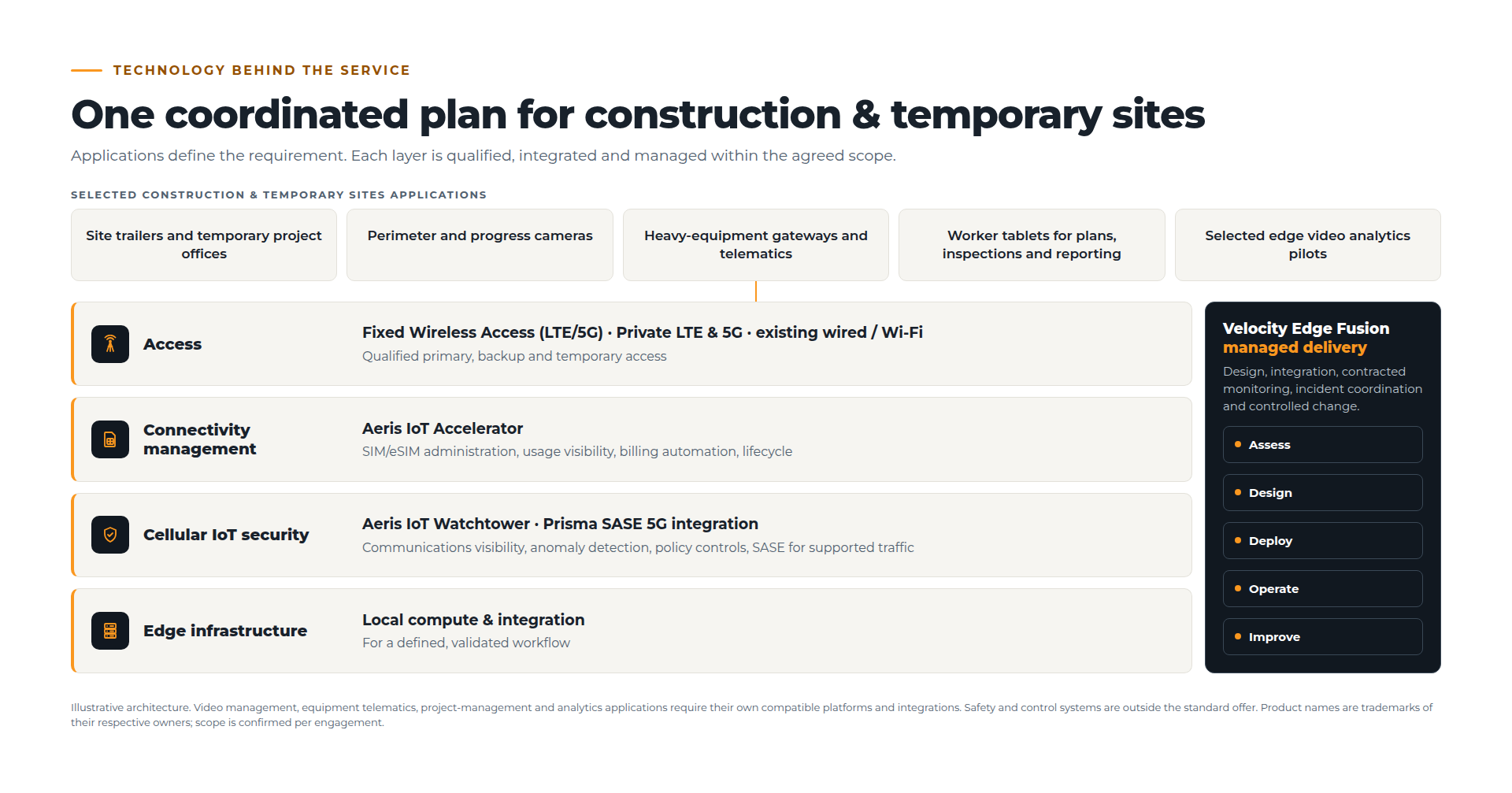
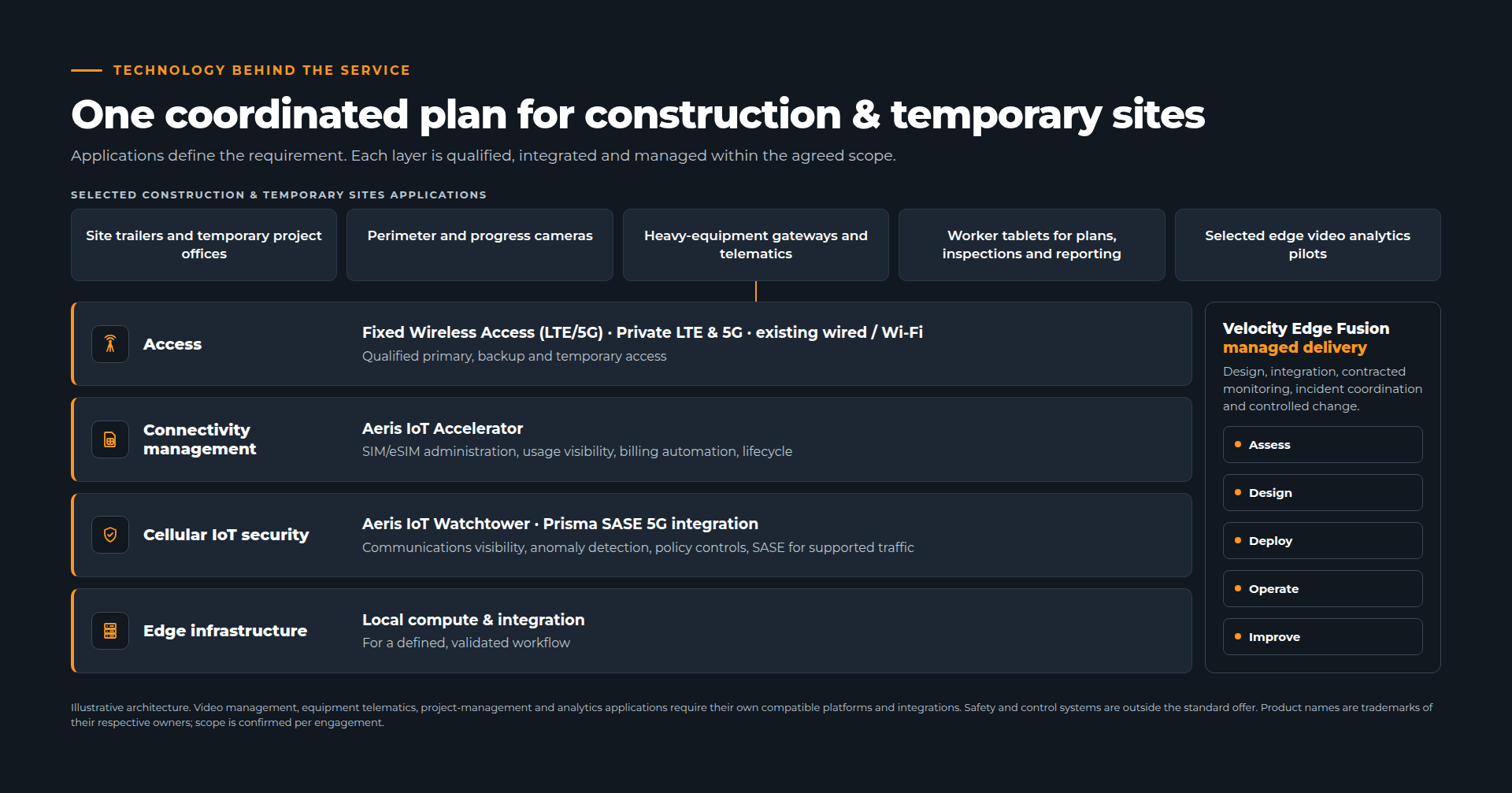
Technology behind the service

Technology behind the service.

Potential technology components, not an automatic bundle. Applications define the requirement; each component is qualified, integrated and managed within the agreed scope.

Diagram: selected construction applications connect through site access, connectivity management, cellular IoT security and edge infrastructure layers, coordinated by Velocity Edge Fusion managed delivery across the project phases.
Availability and scope are confirmed for each engagement. The offerings are not necessarily combined in a single subscription.
OfferingWhat it doesConstruction business useBoundary
Aeris IoT AcceleratorSupported cellular connectivity management, SIM/eSIM administration, billing-related automation and connectivity lifecycle operations.Organize eligible cellular-connected gateways and equipment across projects, locations and responsible teams.Not complete endpoint management, equipment telematics or precision asset tracking.
Aeris IoT WatchtowerSupported cellular communications visibility, anomaly detection and network-layer policy controls.Review unexpected communications and apply approved policies to eligible cellular-connected devices.Does not replace every endpoint, application or site-security control.
Fixed Wireless AccessLTE/5G access for qualified primary, backup and temporary locations.Project offices, trailers, selected remote facilities and approved backup-connectivity applications.Performance, data allowances, installation and availability require location-specific qualification.
Wireless SASEApplicable integration of supported cellular traffic with an enterprise security architecture, including Aeris/Palo Alto Networks capabilities where approved and available.Apply relevant enterprise security policies to eligible cellular connections used by project teams and connected devices.Requires a supported design, appropriate subscriptions and defined security responsibilities.

Product names are trademarks of their respective owners. Mention of a product does not indicate an endorsement or an approved reseller relationship.

Managed delivery

From site qualification to project transition.

  1. 01

    Assess

    Applications, site locations, construction phases, coverage, power, devices, stakeholders and dependencies.

  2. 02

    Design

    Connectivity options, equipment, mounting, security boundaries, access groups, responsibilities and acceptance criteria.

  3. 03

    Deploy

    Install, configure, integrate, document and validate approved equipment and application behavior.

  4. 04

    Operate

    Contracted monitoring, connectivity administration, usage review, incident coordination and controlled changes.

  5. 05

    Improve

    Review recurring issues, capacity, site changes, equipment lifecycle, relocation requirements and transition opportunities.

Service coverage, support windows, field dispatch and response commitments are defined in the agreement.

Requirements and boundaries

Qualify the site. Define the responsibility.

What every engagement qualifies

  • Site-specific coverage and application validation.
  • Device, gateway and network compatibility.
  • Power availability and any agreed power-protection scope.
  • Suitable mounting, antennas and physical installation.
  • Weather, dust, vibration and equipment-rating requirements.
  • Changes caused by structures, obstructions and moving equipment.
  • Data allowances, capacity and application bandwidth.
  • Authorized site access and approved work procedures.
  • Separate owner, general contractor, subcontractor, IT provider, equipment OEM and application-provider responsibilities.
  • Relocation, decommissioning and equipment-return obligations.
  • Contract-defined support windows and service scope.

What we do not promise

  • Guaranteed coverage across every jobsite.
  • Instant activation or a fixed deployment timeline.
  • Uninterrupted operations or guaranteed project completion.
  • Automatic public/private roaming.
  • Precision tracking from SIM management alone.
  • Theft prevention or recovery of stolen equipment.
  • Automatic OSHA, CMMC or other regulatory compliance.
  • Guaranteed productivity gains or financial savings.
  • Certified emergency communications or autonomous-equipment safety.

Emergency communications, life-safety systems, crane control, autonomous equipment control and other safety-critical functions are outside the standard offer unless separately qualified, authorized and explicitly included in the engagement.

FAQ

Questions about construction connectivity.

Related solutions

Related business outcomes

Can you connect a site before a permanent circuit arrives?

The assessment reviews available options, site readiness and application requirements. Availability, equipment and deployment scope must be confirmed before a timeline is agreed.

Can the equipment move to another project?

Relocation depends on the equipment, service terms, coverage, installation requirements and the next site's qualification.

Does this include cameras or equipment tracking?

Those applications require compatible hardware, software and defined integration. Connectivity and application responsibilities are specified separately.

Do we need private 5G?

Not every project requires it. The assessment compares available connectivity approaches against the site's scale, mobility, device and application requirements.

Who handles a service issue?

The agreement defines monitoring, communication, escalation, provider coordination and any field-service responsibilities.

Start with the site that needs to work.

Tell us where the project operates, which applications matter and what is getting in the way. We will help define the assessment, connectivity options and appropriate next step.